


Entitlement Server
Every device.
Entitled instantly.
Our Entitlement Server Solution checks and confirms, in real time, whether a subscriber's plan permits a requested service and then configures the device accordingly. It is built in accordance with the GSMA TS.43 Service Entitlement Configuration specification.
The challenge
Devices need the right configuration, automatically
Every service on a mobile device depends on specific capabilities, both on the device and inside the carrier's network. As companion devices like smartwatches and tablets multiply, keeping service configuration consistent across an operator's whole subscriber base gets harder to do manually.
No automatic visibility into eligibility
Without an entitlement check, a device has no reliable way to know whether the subscriber's plan actually permits a given service.
Manual provisioning doesn't scale
Configuring service capabilities device by device breaks down as subscriber numbers and connected device types grow.
Multi-device consistency
Primary phones, companion smartwatches and tablets all need synchronised service configuration to give a cohesive experience.
Certification complexity
Device vendors each have their own entitlement specifications, so compatibility depends on holding the right OEM certifications.
Platform architecture
Built on the GSMA TS.43 specification
The Entitlement Server sits between the subscriber's device and the operator's network, checking entitlement and returning the result so the device can configure itself accordingly.
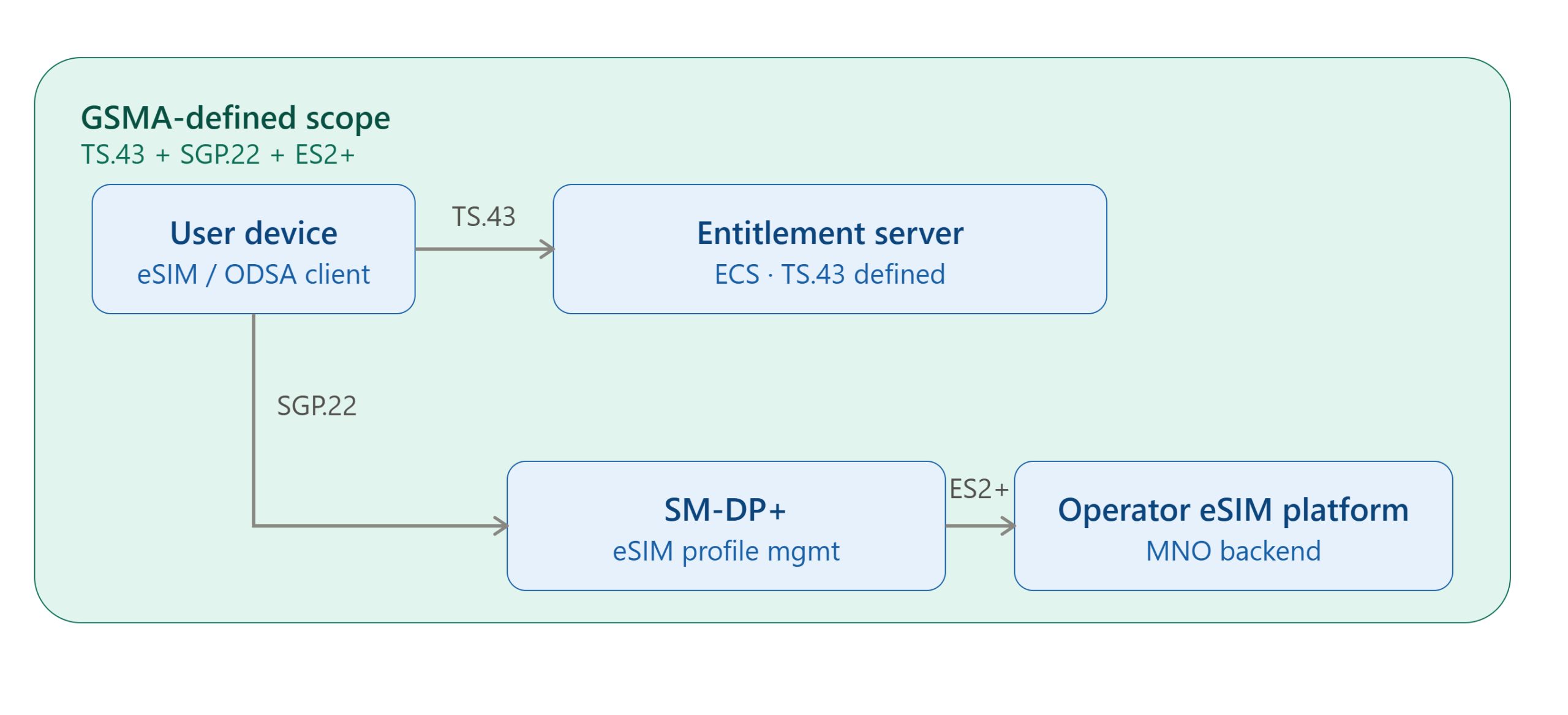
GSMA-defined architecture — the standard reference model, as specified by GSMA TS.43.

Operator-specific implementation — how Card Centric integrates the same Entitlement Server into an operator's live network. Not a universal standard; specifics vary by deployment.
Entitlement server
Entitlements orchestration
Interfaces with the carrier bundle and orchestrates entitlements between the MNO back end and the device.
MNO BSS
Business support system
Confirms whether the subscriber's plan authorises the service.
MNO AAA
Subscriber authentication
Authenticates the subscriber during the entitlement flow.
SM-DP+
eSIM profile management
Handles eSIM downloads, switching and deletion securely on the device, from the cloud.
Websheets
User interaction webpages
A portal that talks to the device and integrates with the MNO's BSS/CRM, for flows like consent, address and T&Cs.
Platform capabilities
What the platform gives you
Standard entitlement checks
Device initiates the check, the Entitlement Server queries the BSS, and the device is told whether the service can be turned on.
Secondary device provisioning
Supports on-device service activation flows for companion devices, coordinated with SM-DP+.
eSIM transfer
Manages the flow when a subscriber moves an eSIM from one secondary device to another.
Account management
Supports plan changes, subscription updates and cancellations through operator-hosted websheets.
Multi-device synchronisation
Keeps service configuration consistent across a subscriber's primary and companion devices.
OEM-compliant integration
Built to the carrier bundle specifications supplied by device vendors, under the operator's direct agreement with each OEM.
Use cases
Where entitlement is used
The most common deployment cases for the Entitlement Server.
VoLTE entitlement
Confirms whether a subscriber's plan permits Voice over LTE before the device enables it.
VoWiFi entitlement
Checks Voice over Wi-Fi eligibility, useful for extending call quality in areas with poor cellular coverage.
5G entitlement
Verifies access to 5G service, often tied to a specific subscriber plan tier.
Secondary device eSIM provisioning
Provisions a companion device such as a smartwatch with the correct eSIM profile.
eSIM transfer
Moves an eSIM subscription from an old secondary device to a new one.
Account management
Handles plan changes, subscription updates and cancellations via operator websheets.
Standards and certifications
Certified to the specifications that matter
Built to GSMA TS.43 and certified against the device vendor specifications that govern entitlement on their ecosystems.
GSMA TS.43
Service Entitlement Configuration, the primary GSMA specification governing entitlement server operation.
Apple Entitlement Ecosystem
Certified to Apple's device entitlement specifications for iOS carrier bundles.
Samsung CDSM 1.13
Certified to Samsung's Companion Device Subscription Management specification.
GSMA RCC.14
Compliant with the Service Provider Device Configuration specification.
RFC 4187 (EAP-AKA)
Supports EAP-AKA authentication as required by the TS.43 flow.
Multi-OEM coverage
Specifications received directly from device vendors, so entitlement works across each MNO's OEM agreements.
Ready to automate service entitlement?
Talk to our team about deploying the Entitlement Server across your device estate.
Connect with our teamFAQ
Common questions
The Entitlement Server lets VoLTE, VoWiFi and VoNR capable devices verify whether the subscriber is authorised to use the service. When a request is received, the Entitlement Server queries the network's provisioning system and tells the device whether the service can be activated.
Examples include gating 5G to a specialised subscriber plan, transferring an eSIM from an old to a new secondary device, offering VoWiFi to a limited group based on location, and seamless eSIM provisioning from a primary to a secondary device. Each operator can define its own scenarios on top of these.
Although the Entitlement Server is based on GSMA TS.43 open standards that apply to most OEMs, for some OEMs, especially Apple, it has to communicate over the Apple carrier bundle. That's why the operator (MNO) separately needs a direct, special contract with Apple to receive the carrier bundle package used in the entitlement server flows.
Any device that supports the GSMA TS.43 specification should theoretically be able to communicate with the Entitlement Server and receive entitlements. However, in practice this is only true for most Android devices, which have TS.43 natively built into their AOSP. Apple devices, on the other hand, use a highly customised scheme aligned with the Apple Carrier Bundle in order to cover the full device landscape with the Entitlement Server.